
Whoa! Okay, so quick confession: I’ve been poking around Solana explorers for years. Seriously? Yep. My instinct said Solscan would keep leading the pack, and for the most part it did. But somethin’ about it still bugs me sometimes. Hmm…
The first time I used Solscan I was chasing a token transfer at 2 a.m. and needed a clean, fast readout. It gave me that. Fast search, clear TX history, and a sane UI when everything else was spitting out confusing numbers. On one hand the UX shines; on the other hand there are features I wish were deeper. Initially I thought the analytics layer was just okay, but then I started using the NFT tracker tools and realized they were actually pretty useful for spotting mint spikes and wash trading patterns. Actually, wait—let me rephrase that: the base explorer is excellent, and the NFT/analytics add-ons are good enough to make me keep coming back.
Short note: explorers are about trust and speed. If an explorer is slow, my gut says something’s off with its nodes or indexing. And Solscan rarely feels slow. There’s a subtle polish to it that matters when you’re watching a memecoin rug-pull or trying to find who minted that blue-chip NFT (or who might be front-running it)…
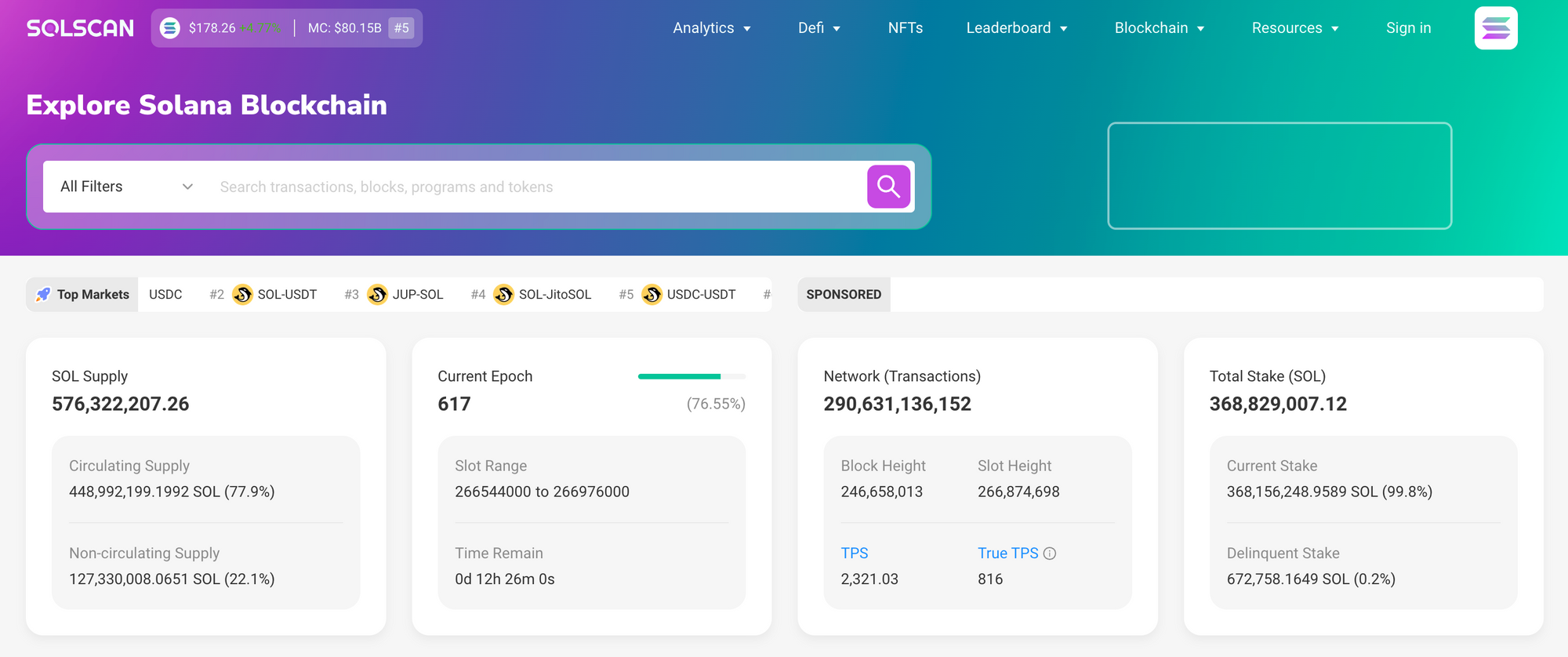
What I use Solscan for — day-to-day and for deep dives
I use it for quick checks. I use it for confirmations. I use it for sleuthing wallets. And when the market gets weird, I use it for pattern analysis. Here are the pieces I go to most often: the transaction viewer, token holders list, NFT collection pages, and the on-chain analytics tabs that summarize supply, liquidity, and top movement. I also keep an eye on contract interactions to see which dApps are seeing volume shifts, and sometimes I’ll overlay that with off-chain chatter to form a hypothesis.
One thing to flag: Solscan’s NFT tracker isn’t just a gallery. It’s a timestamped ledger of mints, transfers, and sometimes royalties paid. That matters. When you can see a sudden flurry of transfers from one or a few wallets, alarm bells should ring. On the flip side, steady, organic-looking distribution often signals genuine collector interest rather than a manufactured pump.
Here’s a practical example. I was watching a small collection that suddenly spiked in volume. At first glance it looked like organic growth. Then I dug into the holder distribution and saw five addresses offloading large chunks within minutes. My first reaction: scam. But then I traced the origins—some of those wallets were marketplaces consolidating for listings. On one hand it looked toxic; on the other hand it was just liquidity work. So, nuance matters.
Okay, so check this out—if you’re tracking an NFT drop, start with the mint tx and follow the first 100 transfers. Seriously. You often catch the pattern within that window. If top holders are dominated by two or three addresses, proceed with caution. If you see lots of unique wallets, that’s usually healthier. I’m biased, but holding a diversified roster of small holders is a sign I like to see.
Solscan’s filters are underrated. You can filter by program id, by token mint, by tx type. Those things let you slice and dice the on-chain noise into something actionable. Also—pro tip—watch for repeated tiny transfers; those can indicate testing or dusting campaigns, and they’re often a precursor to something larger.
But it’s not perfect. The analytics can sometimes feel shallow compared to dedicated analytics suites. On the other hand, it integrates so tightly with the explorer that it’s often faster to just use Solscan for a quick triage. Initially I wanted deep cohort analysis in the same view, but then I realized that speed and clarity beat fancy charts for 70% of my use cases. Though actually, I still want more cohort tools. Someday maybe.
When I need heavier lifting I export data and run quick scripts locally. Yes, that’s extra work. But I like the control. My workflow: glance in Solscan to prioritize leads, export if it’s worth a deeper look, then run my own analyses. This hybrid approach keeps me nimble. Also, on some days I just go down rabbit holes—(oh, and by the way) those rabbit holes are where the best insights live.
How the NFT tracker helps you spot sketchy activity
Short version: timestamps + flow = clues. Longer version: pair mint timestamps with transfer velocity and holder concentration to get a read on health. If 90% of volume happens within the first three hours from a handful of wallets, red flags. If activity is spread over days with many unique wallets, green light. There’s nuance though—sometimes whale collectors will buy early and hold, which skews numbers but isn’t malicious.
Pro tip: use the holders rank view. It shows concentration and often reveals market-making behavior: wallets that buy in bulk and instantly list become visible. Also look at token histories to spot repeated pattern—like buy, transfer to another account, sell. That’s wash-trading red flag behavior. I’m not 100% sure on every case, but repeated patterns are usually telling.
Another small but useful feature: token metadata and creators. Seeing who minted and whether royalties are set tells you a lot about intent. Low royalty/no-royalty projects might be scummy or they might just be experimenters. On the contrary, well-defined royalties don’t guarantee quality, but they do suggest someone thought about sustainability.
FAQ
Can Solscan be used as a primary analytics tool for projects?
Short answer: it can be part of your stack. Longer answer: Solscan provides fast, reliable on-chain reads and useful NFT tracking, but for deep cohort or predictive analytics you’ll want dedicated tools or custom scripts. Use Solscan for triage and quick checks; use exports for heavy analysis.
Is the Solscan NFT tracker reliable for detecting rug pulls?
No silver bullet. It gives indicators—transfer bursts, holder concentration, suspicious wallets—but it won’t “predict” a rug. Combine on-chain signals with off-chain intel (Discord, Twitter), and your own judgment. I’m biased, but I trust combined signals over any single metric.
Where can I find the official Solscan explorer and NFT tracker?
Hit the official site here: https://sites.google.com/cryptowalletextensionus.com/solscan-explorer-official-site/
To wrap up—well, not a neat wrap because I don’t like neat wraps—Solscan is the kind of tool that feels made for people who are impatient but careful. It’s fast, fairly feature-rich, and approachable. I still export and run my own models for heavy work, but for day-to-day exploration and NFT triage it’s my go-to. There’s room to grow. There are things that bug me. But when a transaction needs eyeballs, Solscan is often the place I go first. And honestly, that reliability is priceless.