
Common misconception: a mobile wallet that lists “privacy” in its features automatically gives you perfect anonymity. That’s not how privacy works in distributed systems. Privacy is a property produced by several interacting layers — keys, protocol design, network routing, device security, and the user’s operational choices. Examining a concrete, modern mobile wallet that supports Monero (XMR), Haven (XHV) and other chains helps make those layers visible and decision-useful.
This article uses Cake Wallet as a case study to explain how a privacy-focused multi-currency mobile wallet puts those layers together, what is strong, what remains fragile, and how a U.S.-based privacy-minded user should think about trade-offs when choosing and operating such a wallet on iOS or Android.
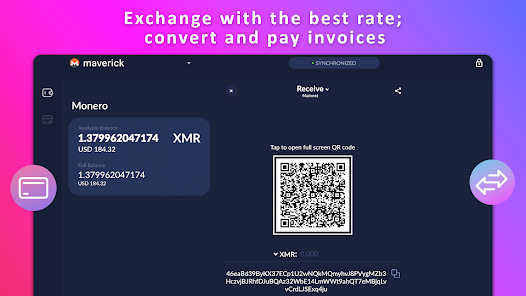
How privacy is assembled: five functional layers
To judge any mobile privacy wallet, separate the engineering stack into five layers. Each layer contributes to real-world privacy in different ways and fails in different modes.
1) Key custody and architecture. Cake Wallet is non-custodial and open-source, so private keys remain under user control and the private view key for Monero never leaves the device. That is foundational: custody determines who can spend funds. But custody alone does not protect metadata (who paid whom) or network-level linkability.
2) Protocol privacy primitives. Monero and Haven use protocol-level privacy: ring signatures, confidential transactions, stealth addresses, and for Haven, asset-mapping to enable private versions of USD-like assets. Cake exposes Monero features such as subaddresses (unique receiving addresses per counterparty) and background synchronization so users don’t have to disclose view keys to third parties. For Bitcoin, privacy is weaker by design, but Cake adds tools like Silent Payments and PayJoin v2 to reduce UTXO linking.
3) Network anonymity. A wallet can implement great protocol privacy and poor network hygiene; the result is still deanonymization risk. Cake Wallet offers Tor-only mode, I2P proxy support, and the option to connect to user-selected nodes. Those choices matter sharply: running your own node or using Tor/I2P reduces the chance that an ISP or a remote node correlates your IP and transactions. But Tor/I2P use has trade-offs in latency and usability, and not all users enable them.
4) Device security. Cake leverages device-level encryption like Secure Enclave on iOS and TPM on Android, protected by a PIN or biometrics. That protects keys from local compromise and casual theft, but it does not prevent sophisticated extraction if the device firmware is rooted/jailbroken or if the adversary has law-enforcement-level access and passcodes.
5) Operational UX and swap routing. Cake supports in-app swaps across many assets via NEAR Intents, enabling decentralized routing among market makers without central custody. That improves usability and reduces the friction that sometimes pushes users to custodial exchanges — but multi-hop swaps and on-chain settlement can leak timing and amount data unless used carefully.
Case analysis: Monero + Haven on a mobile device — where you gain privacy, and where to be cautious
If your primary goal is transaction-level privacy for holdings and payments in Monero and Haven, a wallet that keeps private view keys local, supports subaddresses, and synchronizes in the background addresses several common failure modes. Subaddresses break simple address reuse linkability; keeping the view key on-device avoids handing a third-party a live read on incoming funds. For Haven, which maps off-chain or on-chain assets into private versions, the same principles apply: custody and protocol privacy combine to protect value and transactional history.
However, don’t conflate protocol privacy with threat-model resilience. Network-level leaks — IP addresses or timing correlations — remain a major deanonymization vector. Cake’s Tor-only mode and I2P proxy support materially reduce that exposure, but using these modes is optional and not frictionless. In the U.S. context, where ISPs, mobile carriers, and app telemetry ecosystems are pervasive, the difference between enabling Tor and leaving standard connectivity on is consequential.
Another important caveat: hardware integration. Cake supports Ledger and an air-gapped Cupcake device. Hardware wallets isolate the signing key and provide strong protection against many device-level compromises. The trade-off is convenience: frequent mobile use combined with hardware signing requires an accessible and secure process for air-gapped approval. For many users, the right heuristic is “hot wallet for daily utility; hardware-backed wallet for reserve holdings.”
Comparative trade-offs: Cake Wallet versus three alternative approaches
To sharpen choices, compare three realistic alternatives and highlight what each sacrifices.
A) Non-custodial desktop node (run your own Monero node). Strengths: maximal network privacy and verifiability; you don’t trust remote nodes. Weaknesses: higher technical overhead, less mobile convenience, and poorer UX for rapid swaps. For a U.S. user with stable broadband and privacy-critical needs, this is the strongest privacy posture, but less convenient.
B) Custodial privacy services (mixers, custodial privacy coins on exchanges). Strengths: convenience and liquidity. Weaknesses: custody risk, regulatory exposure, and centralized logs. They can be functionally fast but amplify single-point-of-failure and subpoena risks in the United States.
C) Mobile non-custodial wallet with privacy features (the Cake Wallet case). Strengths: combines non-custodial key control, protocol privacy for Monero and Haven, Tor/I2P options, and in-app swaps via NEAR Intents. Weaknesses: still exposed to device compromise, optional network protections, and lower verifiability than running your own node. Practically, this is the best compromise for users who need mobility but remain willing to adopt safer operational practices.
Mechanisms that matter most — and a reusable heuristic
If you remember one decision framework for mobile privacy wallets, use this three-question heuristic:
1) Custody: are you the only entity with the private keys? If yes, you reduce systemic custody risk. Cake Wallet is non-custodial and open-source, so it clears this bar.
2) Network isolation: do you route wallet traffic through Tor/I2P or your own node? If not, you should assume network-level correlation is possible. Cake offers Tor-only and I2P modes; enabling one is high-value for privacy-conscious users.
3) Device hardening: do you use hardware-backed keys or an air-gapped signer for significant holdings? If you hold substantial value, integrate a Ledger or an air-gapped solution like Cupcake; this materially reduces the damage surface from device compromise.
Limits, unresolved issues, and user errors to watch
Be explicit about boundaries. First, zero telemetry and open-source code reduce but do not eliminate trust: build reproducible builds and independent audits remain best practices. Second, Zcash migration is a concrete friction point: Cake enforces mandatory shielding and notes incompatibility with some Zashi seeds; users migrating funds must manually transfer ZEC when seeds differ. That kind of chain-specific limitation is the kind of operational detail that surprises many users.
Third, swaps and NEAR Intents reduce reliance on centralized exchanges but introduce algorithmic routing complexity; slippage, liquidity fragmentation, or reveal of trade endpoints are possible under certain market conditions. Finally, remember that Tor/I2P can be fingerprinted by usage patterns; using these tools consistently across apps and being careful about unique build identifiers is important.
Practical checklist for U.S. users who want a usable privacy posture
– Keep large reserves in a hardware-backed wallet; use a non-custodial mobile wallet like Cake for day-to-day, smaller-value transactions. – Enable Tor-only or I2P proxy in the wallet and, when possible, run a personal node or connect to a trusted remote node over an encrypted channel. – Use Monero subaddresses for receiving funds and avoid address reuse across services. – Treat built-in swap features as convenience tools; for very large cross-chain trades, consider splitting transactions or using multiple market makers to reduce linkage risk. – Maintain device hygiene: avoid jailbreaking/rooting, keep OS patched, and enable device-level encryption and biometrics.
For more on specific wallet options and multi-chain privacy workflows, see this resource: https://cake-wallet-web.at/
FAQ
Q: If a wallet is open-source and non-custodial, am I completely anonymous?
A: No. Open-source and non-custodial design remove the risk of server-side custody and hidden telemetry, but anonymity depends on network-level protections, device security, and how the protocol itself conceals transaction graph data. For Monero and Haven, protocol privacy is strong, but leaking IPs, timing correlations, or reusing addresses still reduces anonymity.
Q: Should I always use Tor mode on mobile?
A: For privacy-minded users, yes, Tor or I2P significantly reduces ISP-level correlation. The trade-offs are slightly higher latency and occasional connectivity quirks. If you need the strongest privacy consistently, treat Tor/I2P as a standard setting rather than an occasional tool.
Q: How does hardware wallet integration change the threat model?
A: Hardware wallets separate the signing key from the mobile OS. That protects funds if the phone is compromised but not necessarily network metadata. Combine hardware keys with Tor and careful operational practices for the best practical protection.
Q: Is swapping inside a mobile wallet safe for privacy?
A: Swaps improve convenience and can reduce exposure to centralized exchanges, especially when routed decentrally (e.g., NEAR Intents). But swapping can reveal amounts and counterparties depending on liquidity routes. For high-value trades, stagger transactions or consult privacy-preserving OTC options.
Privacy on mobile is not a single setting you turn on; it’s an architecture you assemble. A well-designed wallet like Cake Wallet places many of the correct components within reach — non-custodial keys, Monero/Haven protocol support, Tor/I2P, hardware integration, and no telemetry — but a secure outcome depends on consistent user choices, device hygiene, and an honest appraisal of what remains out of the wallet developer’s control.
In the near term, watch two signals: adoption of mandatory network-proxy defaults in mobile wallets (which would shift the burden from users to the application) and improvements in decentralized swap routing that reduce on-chain linkage. Both would materially lower operational mistakes as a source of deanonymization—but neither is a replacement for good operational discipline.